- October 15, 2026
- Gina Russoniello Tiwari
I have a particular affection for rooms that contain things that, on paper, have absolutely no business being together.
Give me an antique French table with gilded legs and a gorgeous slab of green marble. Put it in a room painted entirely turquoise, ceiling included. Hang a piece of original contemporary art nearby, preferably something with enough personality that a guest is inclined to stop and ask about it.
I love the tension that comes from mixing periods and styles. There is something wonderful about a piece of furniture that has survived a hundred years finding a home alongside work created by an artist who is still very much in the middle of figuring out what they want to say.
And isn’t it amazing when you discover two pieces made half a century or more apart that seem to be in dialogue with one another?
A truly compelling room design might contain several examples of this. Perhaps the curve in a contemporary painting looks as though it could have been created as a cousin to the curve carved into the home’s original molding.
Or the modern glass vase blown in Italy last summer by an artisan who learned his craft from his grandfather (and brought home by you as a memento of your travels) is somehow the exact same shade of cobalt blue as the scarf you found in a vintage shop in New York.
We decide it’s meant to be.
Naturally, we frame the scarf.
Of course, putting together a room with this kind of personality requires some judgment. A room can become visually chaotic if every piece is competing for attention. But when the proportions are right and the materials have been selected carefully, the combination can be extraordinary.
Start With the Pieces You Love
I think people sometimes make decorating unnecessarily difficult by deciding what “style” their home should be before considering what they actually love living with.
They decide they’re going for organic modern, or traditional, or Spanish contemporary, and suddenly everything they purchase has to fit neatly into that category.
I understand the appeal of having a cohesive direction. Personally, I gravitate toward organic interiors. I love natural materials, architectural clarity, and the way a beautifully restrained space allows an extraordinary object to command attention.
But every building has its own architectural character, and I believe a designer has a responsibility to understand that character when approaching the space to implement their own creative direction.
Imagine being entrusted with a centuries-old Italian villa, with beautifully preserved architectural details and generations of history. We consider it a privilege to work within that architecture. You can be certain that contemporary art and unexpected furniture would find their way into the design. But those additions must complement the architecture, making its extraordinary qualities even more apparent.

An overly rigid commitment to a certain aesthetic can lead people to overlook wonderful pieces simply because they don’t fit the label they’ve chosen.
Imagine inheriting your grandmother’s beautifully carved dining table. You’ve always loved it, but your new house has contemporary architecture and you’ve convinced yourself the table won’t work.
Before relegating it to storage, I want to see what happens when we surround it with something unexpected. Perhaps we pair it with sculptural contemporary dining chairs and hang a large piece of abstract art nearby. The craftsmanship of the table takes on an entirely different character in its new surroundings.
Studio Russoniello specializes in incorporating objects that have personal meaning. An inherited piece of furniture or an old family photograph can be every bit as deserving of thoughtful placement as an expensive work of art.
Give the Room a Strong Foundation
When mixing furniture and objects from different periods, proportion is one of the first things I consider.
You can put pieces from wildly different eras together and make them look wonderful, provided they have an appropriate relationship in scale and form.
An elaborately carved cabinet might be spectacular against a clean, contemporary wall. Surround it with several equally ornate pieces, however, and the cabinet may lose some of what made it special.
I often prefer to give an exceptional piece room to breathe.
The same applies to contemporary artwork. A large abstract painting can be breathtaking above a beautifully crafted console, particularly when the scale of the painting gives it enough presence to hold its own against the detail of the furniture.
Architecture and color also play an important role.
When I want a room to communicate a significant point of view, we may explore saturated color, used with conviction. There is absolutely a time and place for color drenching, where the walls, mouldings, and ceiling are painted in the same color, or for tone-on-tone compositions that draw upon different shades of the same general color.
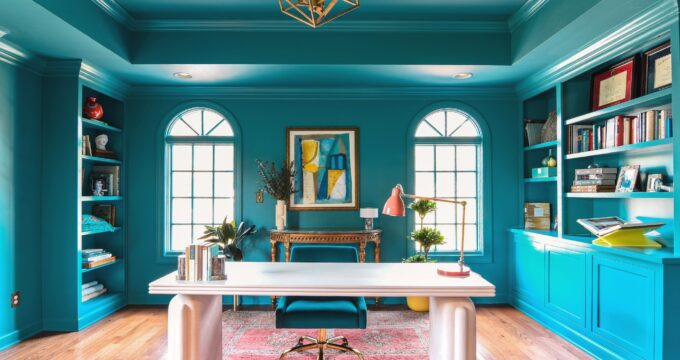
In a turquoise study designed by Studio Russoniello, a contemporary color-drenching treatment creates a remarkable backdrop for a French demilune table, original contemporary artwork, and custom built-in bookcases filled with books collected over a lifetime.
The table has a green marble top and gilded wooden legs. Against the turquoise surroundings, it feels unexpectedly fresh, despite its age.
The color is bold, yes. But using it consistently throughout the room gives the architecture a certain sense of cohesion. I think of a blank canvas that, instead of being white, just so happens to have a color. It is still a backdrop, still a beginning. The furnishings are then free to be as varied as they are.
A plaster finish or stained wood paneling could achieve a similar effect.
I believe architecture and art should guide the design from the beginning. Sometimes that means creating a bold architectural backdrop, as we did in the turquoise study. In other spaces, particularly those with significant historical character, the architecture already provides everything we need. Our job is to understand what makes it exceptional and make thoughtful decisions about what to introduce.

Make Room for Personal History
Some of the most interesting objects in a home have been in a family for generations.
My great-grandfather, Vincenzo Luigi Russoniello, emigrated from Italy to Pennsylvania and spent his career as an architect. He designed churches and other buildings that became important parts of his community, while continuing to source materials from his native Italy.
I have a photograph from 1930 showing him and his team standing on the steps of a church they were building.
It’s one of my most treasured possessions.
The photograph is professionally framed, with a picture light mounted above it and a marble shelf below. On that shelf sits a tape measure that belonged to his son, my grandfather Louis Vincent Russoniello, who followed in his father’s footsteps and became an architect in the family business.
I love having these pieces together. The photograph captures one generation at work, while the tape measure belonged to the next. The objects themselves are worth very little in material terms, but their provenance makes them priceless to me. I wanted to give them the kind of attention someone might ordinarily reserve for a valuable painting.
I think people sometimes underestimate how visually interesting their own histories can be.
An old family photograph may have an extraordinary composition. An inherited piece of furniture may display craftsmanship that would be difficult to reproduce today. These objects deserve to be considered on their artistic merits as well as their sentimental value.
There’s tremendous pleasure in finding an unexpected way to present something familiar. A cherished ottoman might be reupholstered in a daring textile. A photograph, a sketch, or a manuscript might become the centerpiece of a contemporary gallery wall.
And that curiosity can extend to contemporary artists and artisans, particularly those who have inherited traditional techniques and found unexpected ways to use them. I love the idea of a home continuing to welcome new discoveries as the interests of the people who live there evolve.
A Home That Feels Like Yours
I’m quite certain that if you’re reading this, you have an interesting story to tell about how you wound up where you are today.
I find tremendous pleasure in bringing together objects that communicate the ideas and experiences that have shaped a person’s life. Pieces acquired decades apart may turn out to have an unexpected visual connection. An old family possession might find its perfect home in a thoroughly modern room.
The more personal the collection becomes, the more interesting the possibilities.
At Studio Russoniello, our work is grounded in architectural discipline, natural materials, and an appreciation for exceptional craftsmanship. We love contemporary art and the occasional unexpected design choice. We enjoy getting to know the people who will inhabit a space, learning which objects they treasure, and helping them discover things they may never have thought to put in their homes.
I want clients to feel that their spaces are full of beautiful things they genuinely love, including a few things that might surprise them.
After all, the most interesting people do not fit neatly into a single category. Why should their homes?

Bring your own story into the design.
Studio Russoniello is an art-forward interior design studio based in Hickory, North Carolina, serving Charlotte, Lake Norman, and select projects beyond. We create distinctive interiors grounded in thoughtful architecture and natural materials, enriched by original artwork and the personal stories of the people who live within them.